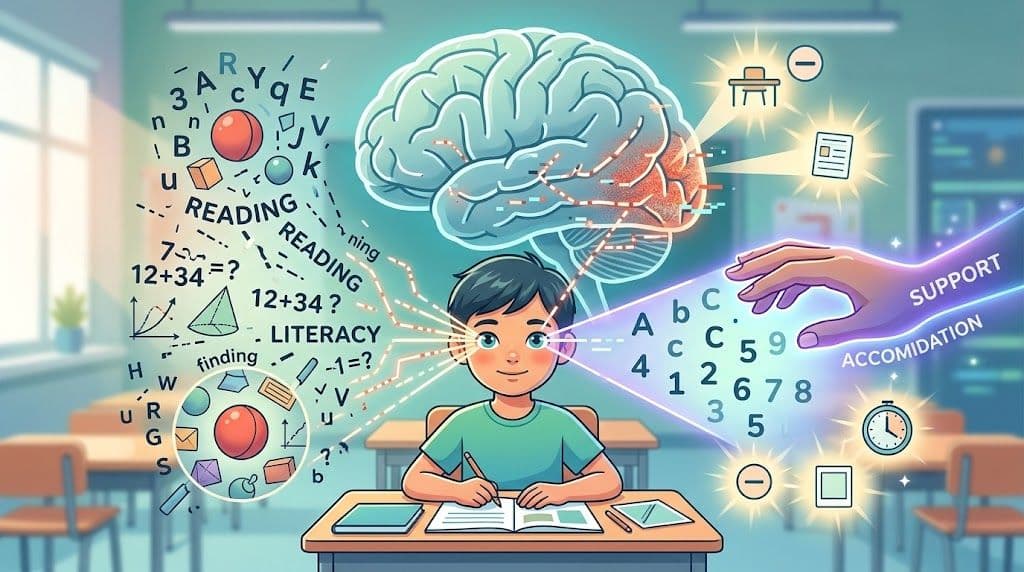
Cerebral visual impairment (sometimes called cortical visual impairment or CVI) is a disorder caused by damage to the parts of the brain responsible for processing vision. Since visual processing plays an important role in classroom learning, CVI can affect teaching and learning.
CVI is being recognized more often today, partly because more children born prematurely, or affected by conditions like hypoxic-ischemic encephalopathy (a lack of oxygen to the brain around birth), are surviving and reaching school age. Unlike visual impairment caused by problems with the eyes, CVI results from difficulties in the brain’s processing of visual information. Therefore, a person’s eyes may appear healthy while they still have difficulty looking at or recognizing what they see.
CVI does not affect everyone in the same way. The difficulties experienced depend on the areas of the brain affected and the visual functions involved. For example, a learner may be able to see an object but struggle to recognize it, while another may have difficulty finding the object in the first place. These difficulties can also change depending on the environment. A child may easily identify a familiar red ball against a plain background but struggle to find it when it is surrounded by other objects.
CVI can negatively affect academic performance, particularly in areas that require visual processing. A study of 1,129 first-grade children found that children with CVI-related visual difficulties performed significantly worse in early literacy and mathematics than typically developing children, even after controlling factors such as socioeconomic status, parental education, and age.
Firstly, CVI can negatively affect early literacy in children. Early literacy has many facets, including the ability to understand the sound structure of spoken words, recognize written letters and symbols, notice differences and similarities between things that are seen, and identify individual words in spoken or written language. In literacy, multiple letters and symbols are combined to form words and sentences. In such situations, a child with CVI may struggle to identify letters and symbols because of visual crowding. This difficulty with visual recognition can affect their ability to identify words and syllables and process written material, consequently affecting their reading.
Secondly, children with CVI-related visual difficulties can perform significantly lower in mathematics than typically developing children. Mathematics involves a considerable amount of visual-spatial processing. A child with CVI may have difficulty organizing calculations on a page, aligning numbers correctly, understanding the position of numbers, recognizing shapes and geometric figures, identifying objects and figures visually, mentally manipulating figures such as rotating them, and accessing numerical information presented on paper. These difficulties in interpreting visual mathematical information can make some mathematical tasks more challenging.
Notably, CVI doesn't affect every kind of learning equally. When information is spoken aloud instead of shown visually, children with CVI understand it just as well as anyone else. Many lean on hearing and other senses to make up for what their vision struggles with. In other words, CVI isn't a general learning problem. It specifically affects tasks that demand a lot from the eyes and brain's visual system.
Most teachers simply haven't been taught to recognize CVI. Without that awareness, a child's visual struggles can easily be mistaken for not paying attention or not trying hard enough, when really their brain is working overtime just to make sense of what's in front of them.
A few simple classroom adjustments can make a big difference:
• Reducing classroom clutter
• Simplifying boards, worksheets, or screens
• Minimizing unnecessary movement in the visual field
• Using consistent, structured routines
• Allowing extra processing time for visually demanding tasks
CVI can affect teaching and learning because many classroom activities depend on the ability to process visual information. Its effects can be seen particularly in areas such as early literacy and mathematics, although the extent of the difficulty varies from one learner to another. Therefore, supporting learners with CVI requires more than simply recognizing that they have a visual impairment. Teachers need to understand how CVI can affect the processing of classroom information and adapt the learning environment accordingly. Increasing teachers’ awareness of CVI and reducing unnecessary visual demands in the classroom can help create a more accessible learning environment and give learners with CVI a better opportunity to participate and learn effectively.
REFERENCES
Perkins School for the Blind. (2026). What is CVI? National Eye Institute. (2024, December 4). Cerebral visual impairment (CVI). National Institutes of Health Matsunaga, K., Avramidis, K., Borchert, M. S., Narayanan, S., & Chang, M. Y. (2025). Method for assessing visual saliency in children with cerebral/cortical visual impairment using generative artificial intelligence. Frontiers in human neuroscience, 18, 1506286. https://doi.org/10.3389/fnhum.2024.1506286. Jayasinghe, A., St Clair Tracy, H., Ravenscroft, J., & Blaikie, A. (2025). The CLASS (Cerebral visual impairment Learning and Awareness for School Staff) Pilot Study: An evaluation of the awareness of CVI amongst teachers and comparative evaluation of two different educational resources on understanding. PloS one, 20(6), e0324914. https://doi.org/10.1371/journal.pone.0324914