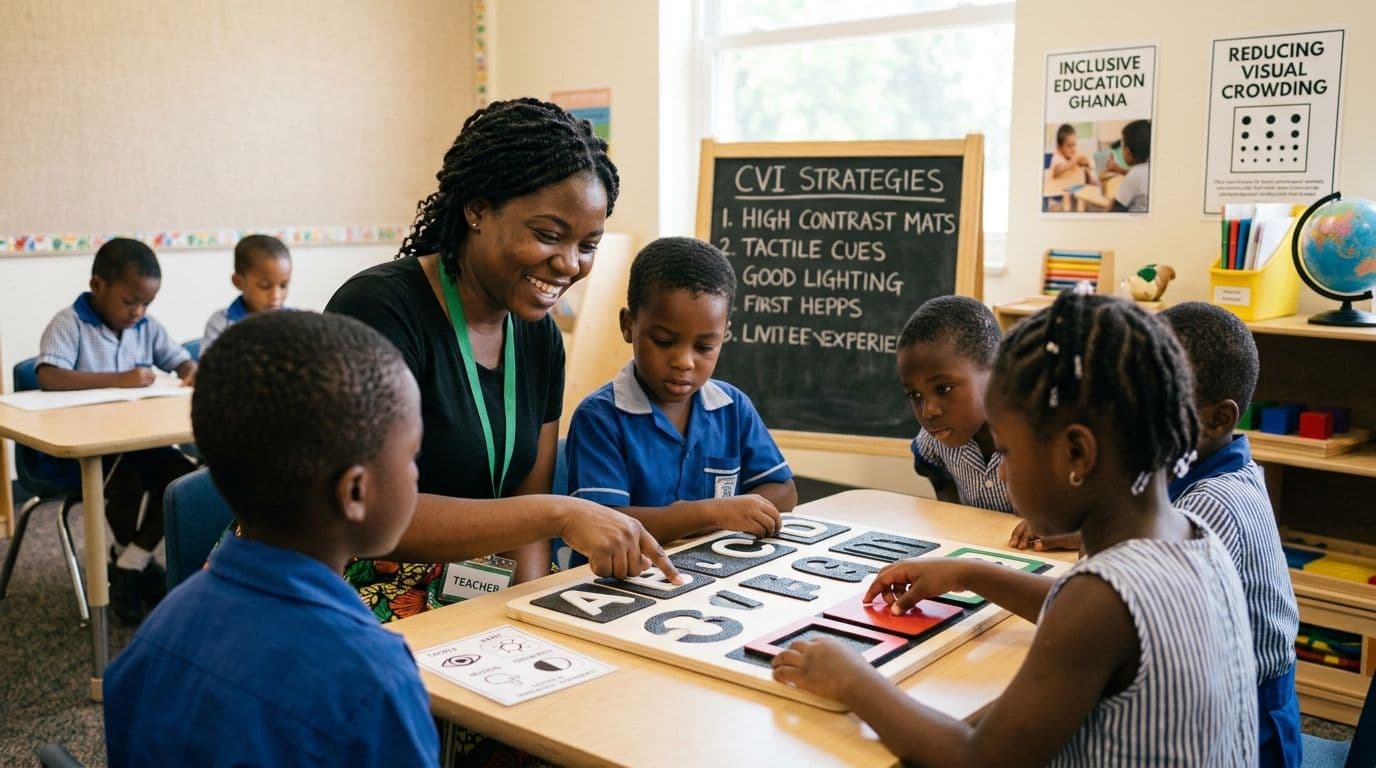
Classroom Strategies for Children with CVI in Ghana
Early literacy contains a large amount of visual information. For children with cerebral visual impairment (CVI), however, processing this information can be challenging. CVI is a brain-based visual impairment that affects how the brain interprets visual information. A child may be able to see an object but struggle to recognize it, find it among other objects or understand what they are seeing. This can make activities such as reading from the board, finding objects and interpreting pictures more difficult.
In Ghana, information specifically focused on CVI appears limited. Much of the available research addresses visual impairment more generally. This can make it difficult for teachers and parents to recognize CVI and understand that a child's difficulty may not simply be “poor vision” or lack of attention. Challenges such as limited teacher training, inadequate learning materials, and insufficient specialist support for children with visual impairments are hindrances in dealing with visual impairments in Ghana.
Raising awareness is therefore an important step in addressing CVI. Here are eight classroom strategies that Ghanaian teachers can use to make learning more accessible for children with CVI.
1. Reduce visual clutter
Busy walls, crowded desks, and complicated worksheets can make it harder for a child with CVI to focus. Keep only the materials needed for the current activity within the child's visual field.
2. Present one thing at a time
When introducing pictures, objects, or questions, avoid presenting too many at once. Cover unused sections of worksheets or introduce objects individually to reduce the amount of information the child has to process.
3. Use color purposefully
A consistent color can help draw attention to important information or identify a child's materials and classroom spaces. Avoid using too many colors, as this can create additional visual clutter. Colors such as red and yellow may be easier for some children with CVI to notice and identify
4. Use clear contrast
Place important objects and learning materials against simple, contrasting backgrounds. For example, presenting an object on a plain surface may make it easier to identify than placing it on a patterned background.
5. Simplify worksheets
Reduce unnecessary pictures, and information on worksheets. Increasing spacing and presenting fewer questions at a time can make a page easier to process.
6. Give extra processing time
A child with CVI may need more time to recognize and interpret what they see. After showing a picture, object, or word, pause before expecting an answer. Waiting can give the child the opportunity to demonstrate what they know.
7. Use multiple senses
Combine visual information with sound and touch where possible. For example, when teaching a letter, a teacher can show it, say its sound, and allow the child to trace its shape.
8. Keep the classroom predictable
Keep frequently used materials in consistent locations and maintain clear pathways. A predictable environment can reduce the amount of visual searching a child has to do and make it easier to navigate the classroom.
CVI affects children differently, so there is no single strategy that will work for everyone. However, simple changes such as reducing clutter, simplifying materials and allowing more processing time can remove unnecessary barriers to learning.
References
- Perkins School for the Blind. What Every Teacher Should Know About CVI.
- Perkins School for the Blind. CVI for Teachers of Students with Visual Impairments.
- Perkins School for the Blind. These 9 Easy Classroom Adaptations Can Help Kids with CVI.
- Kyei-Arthur, F., Kyei-Gyamfi, A., & Kyei-Gyamfi, S. (2026). Teaching and learning challenges for children with visual impairments in Ghana: A qualitative study of teachers' experiences. Journal of Research in Special Educational Needs. (nasenjournals.onlinelibrary.wiley.com)
- Awini, A. (2025). Teacher pedagogical strategies in early childhood education for learners with visual impairment in Ghana. (uew.edu.gh)